Introduction: Is HVAC Technology a Good Career in the USA?
A broken furnace in January or a failed chiller in a hospital cannot wait for a convenient career cycle. Exploring the HVAC Technician Career Path in the USA helps you evaluate training time, daily duties, salary, licensing, job demand, and long-term advancement before you spend money on school or tools.
In 2026, homes, offices, hospitals, data centers, schools, and manufacturing facilities all depend on reliable climate-control systems. According to the U.S. Bureau of Labor Statistics, the occupation is projected to grow 9% from to 2033, faster than the average for all occupations.
Based on our research, the route is flexible: you can begin after high school or a GED, attend a 6-to-12-month technical program, enter a paid apprenticeship, earn EPA certification, and specialize in equipment such as heat pumps, refrigeration, controls, or commercial systems. Later options include lead technician, service manager, estimator, contractor, instructor, or business owner.
Exploring the HVAC Technician Career Path in the USA makes sense if you enjoy hands-on problem-solving, electrical and mechanical diagnosis, and visible results. It is not effortless work, but recurring maintenance, replacement demand, and multiple specialties can make it a stable and worthwhile choice when you value safety, dependable service, and continued learning.
What Does an HVAC Technician Do?
An HVAC technician installs, inspects, diagnoses, repairs, and maintains heating, ventilation, air conditioning, and refrigeration equipment. A residential technician may replace a capacitor and clean an evaporator coil; a commercial technician may troubleshoot a rooftop unit serving a 20,000-square-foot store; an industrial technician may work on process cooling; and a refrigeration specialist may protect food inventory in a supermarket or cold-storage warehouse.
A realistic day begins by reviewing dispatch information, equipment history, and safety notes. You may test voltage and amperage with a multimeter, check refrigerant pressure with manifold gauges, recover refrigerant, pull a vacuum, locate a leak, document the repair in a digital platform, and explain replacement or repair options to a customer. We found that clear documentation often separates technicians who advance from those who repeatedly revisit the same problem.
Exploring the HVAC Technician Career Path in the USA also means accepting physical demands. You may climb ladders, work outdoors in 100°F weather or below-freezing conditions, enter crawlspaces, lift compressors, kneel for long periods, and respond to emergency calls during peak summer or winter demand. Carbon monoxide, electricity, moving belts, refrigerant, and combustion equipment require strict procedures.
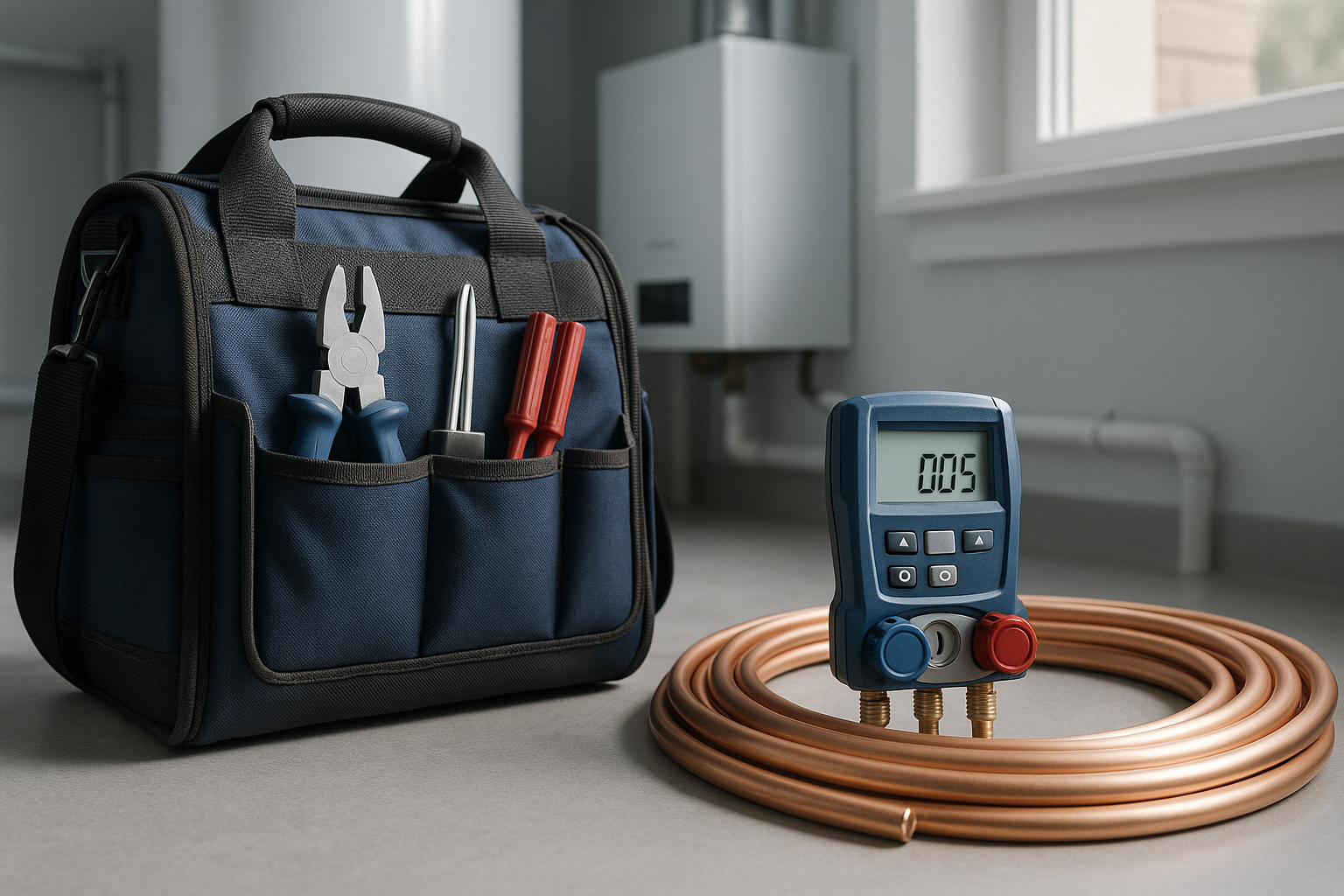
Core tools include multimeters, clamp meters, manifold gauges, vacuum pumps, recovery machines, electronic leak detectors, combustion analyzers, thermometers, airflow meters, and personal protective equipment. Exploring the HVAC Technician Career Path in the USA is best suited to someone willing to combine mechanical skill, basic mathematics, safe work habits, customer communication, and accurate digital records.
How to Become an HVAC Technician in the USA
Use this practical sequence: earn a high school diploma or GED; strengthen algebra, electrical, and mechanical fundamentals; compare technical programs; obtain supervised field experience; pass required exams; earn EPA Section certification; and apply for helper or apprentice positions. You do not need to know every repair before your first job, but employers expect reliability, safe conduct, and a willingness to learn.
Trade schools commonly take to months and may cost roughly $4,000 to $20,000. Community-college certificates can take to months, while employer training and union apprenticeships may cost less upfront because you earn wages; paid apprenticeships commonly last to years. Based on our analysis, compare graduation rates, lab hours, employer connections, tool costs, and placement results—not just advertised tuition.
Exploring the HVAC Technician Career Path in the USA can begin with a helper role and progress to apprentice, journeyman, senior technician, service manager, estimator, contractor, or owner. A sample first year looks like this:
- Months 1–3: complete safety, electrical, refrigeration, and airflow coursework; obtain basic hand tools and workwear.
- Months 4–6: study for EPA 608, build a résumé, and apply to contractors, facilities departments, and union programs.
- Months 7–9: work under supervision, document equipment types and repairs, and practice wiring diagrams and measurements.
- Months 10–12: earn certification, request feedback, and target a permanent apprentice or junior service position.
Accelerated training may make you employable in months, but proficiency takes years of supervised troubleshooting. Exploring the HVAC Technician Career Path in the USA works best when classroom knowledge and field repetition develop together.
HVAC Training, EPA Certification, and State Licensing
EPA Section certification is the federal credential required for technicians who handle regulated refrigerants. Type I covers small appliances, Type II covers high-pressure appliances, Type III covers low-pressure appliances, and Universal certification covers all categories. The U.S. Environmental Protection Agency explains the certification categories and refrigerant-handling rules.
Federal certification does not replace local licensing. Some states license individual technicians, while others mainly license contractors; counties and cities may impose additional permits, registration, supervision, or exam requirements. Verify rules through your state licensing board and municipal building department rather than trusting a job listing that may be outdated by several years.
A sensible credential sequence is EPA first, employer or manufacturer training next, and specialty qualifications afterward. NATE certification, HVAC Excellence credentials, OSHA safety training, gas qualifications, electrical credentials, and manufacturer courses can strengthen your application when they match the equipment you service.
Exploring the HVAC Technician Career Path in the USA requires paperwork discipline as well as technical ability. We recommend keeping digital copies of certificates, renewal dates, exam results, and documented training hours. Exploring the HVAC Technician Career Path in the USA becomes easier when you choose credentials based on your intended work—such as commercial refrigeration, gas heating, controls, or heat pumps—rather than collecting unrelated certificates.
HVAC Technician Salary, Benefits, and Earning Potential
The BLS reported median annual pay of $59,810 for heating, air conditioning, and refrigeration mechanics and installers in May 2023. The lowest 10% earned less than approximately $38,000, while the highest 10% earned more than approximately $84,000; overtime, commission, union agreements, specialty, and location can move actual earnings well beyond those benchmarks.
Helpers and apprentices may begin around $16–$25 per hour, depending on market and experience. Experienced residential service technicians may reach $60,000–$90,000, while commercial refrigeration, controls, industrial service, supervisors, and high-demand emergency technicians can exceed $100,000 in certain markets. These are practical ranges, not guarantees. Housing costs matter: a higher wage in a major metropolitan area may provide less purchasing power than a lower wage in a rural region.
Exploring the HVAC Technician Career Path in the USA should include total compensation, not just hourly pay. Compare health insurance, retirement contributions, paid training, tool allowances, company vehicles, fuel cards, commissions, overtime, holiday pay, and emergency-call premiums. A technician earning $29 per hour with benefits and predictable overtime may be better positioned than someone earning $35 with no insurance or retirement plan.
For example, a technician might move from $42,000 as a helper to $58,000 after EPA and manufacturer training, $76,000 after mastering commercial equipment, and $95,000 after adding controls, sales ability, and after-hours availability. Exploring the HVAC Technician Career Path in the USA shows why difficult equipment and dependable customer communication can raise income as much as tenure alone.
HVAC Job Outlook and Demand Through 2034
The BLS projects 9% employment growth for HVAC mechanics and installers from through 2033, with about 40,100 openings each year from growth and replacement demand. Aging equipment, new construction, extreme temperatures, indoor-air-quality concerns, and required maintenance all support hiring. The BLS occupational outlook is the best starting point for current national data.
Demand comes from residential heat pumps, commercial building maintenance, cold-storage facilities, hospitals, schools, semiconductor plants, data centers, and manufacturing. A data center may need constant cooling and redundancy; a hospital needs documented reliability; a school district may need technicians who can service dozens of rooftop units across multiple buildings.
Refrigerant rules are also changing. The EPA’s Technology Transitions program is moving many sectors toward lower-global-warming-potential alternatives, creating demand for technicians who understand updated equipment, recovery procedures, mildly flammable refrigerants where permitted, and manufacturer instructions. The EPA climate and HFC information should be checked before relying on older training materials.
Exploring the HVAC Technician Career Path in the USA reveals regional differences: cooling-heavy states often hire strongly before summer, while northern markets surge before winter. Technicians who can service both heating and cooling systems may find steadier year-round work. Exploring the HVAC Technician Career Path in the USA can be recession-resistant in maintenance, but construction slowdowns and local business closures can still reduce openings.
Choosing an HVAC Specialization
Residential service offers local routes, frequent customer interaction, and fast exposure to furnaces, air conditioners, heat pumps, and indoor-air-quality products. Commercial HVAC involves rooftop units, chillers, boilers, pumps, variable-air-volume systems, and larger electrical controls. Industrial work adds process cooling and strict plant procedures; refrigeration serves supermarkets, restaurants, warehouses, and food production.
Controls and building automation are an undercovered path. You may diagnose sensors, actuators, variable-frequency drives, controllers, building-management systems, and energy-management software rather than replacing compressors all day. This work can involve more commissioning, programming, networking, and documentation, with strong earning potential for technicians who understand both HVAC operation and low-voltage controls.
Heat-pump growth is changing the skill mix. You need electrical diagnostics, airflow measurement, commissioning, defrost-cycle knowledge, refrigerant fundamentals, and low-temperature operating knowledge. Commercial kitchen equipment and indoor-air-quality work add specialized ventilation, make-up air, filtration, exhaust, and combustion concerns.
Use this decision test: choose residential if you prefer local customer calls; commercial or industrial if you want more complex equipment; refrigeration if emergency uptime interests you; controls if you enjoy sensors and software; and heat pumps if electrification appeals to you. Exploring the HVAC Technician Career Path in the USA helps you match schedule, travel, physical demands, customer contact, troubleshooting depth, and income goals. Exploring the HVAC Technician Career Path in the USA should lead to a specialty you can practice repeatedly, not merely one with an attractive wage advertisement.
Tools, Technology, and Skills That Set Technicians Apart
Begin with insulated screwdrivers, nut drivers, wrenches, pliers, tubing tools, a digital multimeter, clamp meter, temperature probes, safety glasses, gloves, hearing protection, and a reliable tool bag. As your work expands, learn recovery machines, scales, vacuum pumps, micron gauges, leak detectors, combustion analyzers, airflow hoods, and appropriate fall-protection equipment under supervision.
Electrical diagnosis, airflow measurement, refrigeration theory, brazing, combustion safety, wiring diagrams, pressure-temperature relationships, and basic mathematics matter more than memorizing part numbers. For example, measuring low voltage, static pressure, temperature split, superheat, and subcooling can reveal the cause of a complaint before you replace an expensive component.
Modern technicians may use wireless probes, remote monitoring, fault-code software, smart thermostats, connected equipment, and digital maintenance records. We tested similar digital workflows in field-oriented planning and found that timestamped measurements and photographs reduce repeated visits and make estimates easier to defend.
During your first year, track equipment types, completed repairs, certifications, diagnostic measurements, callbacks, and measurable results such as reduced temperature complaints or improved airflow. Exploring the HVAC Technician Career Path in the USA rewards punctuality, accurate estimates, ethical recommendations, calm communication, and clean documentation. Exploring the HVAC Technician Career Path in the USA becomes more valuable when your résumé can show furnace inspections, heat-pump calls, five brazing jobs, and documented safety training rather than simply “familiar with HVAC.”
The Real Costs and Risks of an HVAC Career
A realistic beginner budget may range from $5,000 to $25,000. Tuition can cost $4,000–$20,000, basic tools $500–$2,000, workwear and boots $200–$600, transportation $1,000 or more if you need a dependable vehicle, and EPA or other exams roughly $50–$200. Continuing education, manufacturer classes, insurance, and replacement tools add recurring costs.
Risks include electrical shock, refrigerant exposure, burns, falls, carbon monoxide, heavy lifting, heat stress, sharp sheet metal, and driving between calls. The Occupational Safety and Health Administration identifies heat exposure as a serious workplace hazard, while lockout/tagout, gas testing, fall protection, refrigerant recovery, PPE, and documented safety training reduce preventable incidents.
Schedules can include weekends, emergency calls, peak-season overtime, outdoor work, and pressure from customers whose homes or businesses are uncomfortable. Before accepting an offer, ask for the wage structure, training plan, tool policy, benefits, average call volume, safety record, advancement process, driving expectations, and on-call rotation in writing.
Exploring the HVAC Technician Career Path in the USA is a financial decision as well as a career decision. We recommend comparing the employer’s investment in safety and training with its promises about earnings. Exploring the HVAC Technician Career Path in the USA should never mean accepting unsafe shortcuts because a company is busy; a good employer explains procedures, supplies necessary PPE, and gives new technicians supervision before assigning high-risk work.
How to Get Your First HVAC Job and Advance Faster
Apply to HVAC contractors, facilities departments, manufacturers, union locals, commercial property companies, schools, hospitals, equipment distributors, and refrigeration firms. A beginner résumé can highlight mechanical projects, electrical coursework, customer-service work, military experience, warehouse responsibility, EPA certification, a clean driving record, and reliable transportation. One completed engine, wiring, plumbing, or appliance project can demonstrate useful troubleshooting habits.
Prepare concise interview examples. For a troubleshooting question, explain how you would verify the complaint, inspect safely, test from the power source toward the load, compare readings with specifications, and document the result. For a difficult customer, describe listening without arguing, explaining the evidence, presenting options honestly, and asking for help when the repair exceeds your authority.
Your first days should be deliberate:
- Master lockout/tagout, PPE, vehicle safety, refrigerant handling, and company emergency procedures.
- Learn the dispatch, estimate, inventory, and documentation systems.
- Shadow experienced technicians and record measurements rather than only watching repairs.
- Practice diagnostics on supervised calls and request weekly feedback.
Exploring the HVAC Technician Career Path in the USA can lead to lead technician, field supervisor, estimator, service manager, controls specialist, instructor, contractor, or business owner. Exploring the HVAC Technician Career Path in the USA advances faster when you ask for measurable responsibilities—such as handling maintenance visits, closing estimates, or mentoring a helper—instead of waiting passively for a new title.
Conclusion: A Practical Next-Step Plan for 2026
HVAC offers comparatively short entry routes, recurring demand, multiple specialties, and several ways to increase earnings through skill development. In 2026, heat pumps, data centers, commercial maintenance, refrigerant changes, and aging equipment are creating work for technicians who can diagnose safely and explain repairs clearly.
Exploring the HVAC Technician Career Path in the USA should end with action, not speculation. First, check state, county, and city requirements. Next, compare three training options, calculate tuition and tool costs, research EPA Section preparation, contact local employers, and apply for helper or apprentice positions. Before paying tuition, speak with at least two working technicians and visit a training lab so the classroom promise matches the physical reality.
Set a 12-month review date. Measure your certifications, equipment experience, income, schedule, callbacks, and preferred specialty. Then decide whether to pursue commercial systems, refrigeration, controls, heat pumps, supervision, or additional licensing.
Based on our research, long-term success depends less on memorizing every model number than on safe testing, continued learning, dependable attendance, honest recommendations, and methodical diagnosis. Exploring the HVAC Technician Career Path in the USA is ultimately an invitation to build a practical trade one verified measurement, completed repair, and trusted customer interaction at a time.
Key Takeaways
- HVAC can offer a relatively short entry route, with accelerated programs often taking 6–12 months and apprenticeships commonly lasting 3–5 years.
- EPA Section certification is essential for technicians who handle regulated refrigerants, while state and local licensing rules vary widely.
- The BLS reported median HVAC technician pay of $59,810 in May and projected 9% employment growth from through 2033.
- Commercial HVAC, refrigeration, controls, heat pumps, and industrial systems can provide strong advancement opportunities for technicians who build specialized skills.
- Your best next step is to compare three training options, verify local requirements, speak with working technicians, and apply for supervised entry-level work.
Frequently Asked Questions
How long does it take to become an HVAC technician?
Many accelerated HVAC programs take about to months, while paid apprenticeships commonly last to years. You can often begin as a helper while completing training and then progress toward more advanced service work.
What certification does an HVAC technician need?
EPA Section certification is required when you service equipment containing regulated refrigerants. Type I covers small appliances, Type II covers high-pressure systems, Type III covers low-pressure systems, and Universal certification covers all three categories.
How much do HVAC technicians make in the USA?
The U.S. Bureau of Labor Statistics reported median annual pay of $59,810 for heating, air conditioning, and refrigeration mechanics and installers in May 2023. Actual earnings vary by region, overtime, specialty, union status, commission, and experience.
Is HVAC a good career in 2026?
HVAC work can provide stable employment because heating, cooling, ventilation, and refrigeration equipment require recurring maintenance and repair. However, construction cycles, seasonal demand, physical demands, and local economic conditions still affect job availability.
What is the highest-paying HVAC specialty?
The best specialty depends on your preferred schedule, work environment, and technical interests. Commercial HVAC, refrigeration, controls, and industrial service can offer strong earning potential, while residential work may provide faster entry and more local job opportunities.
Do HVAC technicians need a state license?
Yes, but you should confirm requirements with your state licensing board, county, and city. Some jurisdictions license individual technicians, while others mainly license the contractor who supervises or contracts for the work.
