Introduction: Is Genealogy a Viable Career in the USA?
Exploring the Genealogist Career Path in the USA can become paid work, but it is not simply a matter of copying names into an online tree. Clients pay for defensible answers about identity, migration, inheritance, adoption, and family history. Exploring the Genealogist Career Path in the USA therefore suits you best if you enjoy patient investigation, incomplete evidence, and writing conclusions that can withstand questions.
In 2026, digitized collections and consumer DNA testing continue to bring new clients into genealogy. The U.S. National Archives describes federal records that support family research, while FamilySearch reports billions of searchable historical images and records. Demand also comes from probate firms, immigration projects, adoption searches, and people trying to interpret DNA matches.
You should distinguish among several roles:
- Professional genealogist: researches for paying clients or an employer.
- Hobbyist: studies personal or family history without commercial obligations.
- Historical researcher or archivist: manages, interprets, or locates historical collections.
- Genetic genealogy specialist: combines DNA data with documentary research.
- Forensic genealogist: supports legal, missing-person, or unidentified-remains investigations under defined authority.
There is no single national salary or mandatory degree. Earnings depend on specialty, pricing, credentials, location, and whether you work hourly, salaried, or project by project. We researched the field and found that credibility grows from documented results, not from a family tree containing 10,000 unsourced names.
What Does a Genealogist Do? Core Duties and Specialties
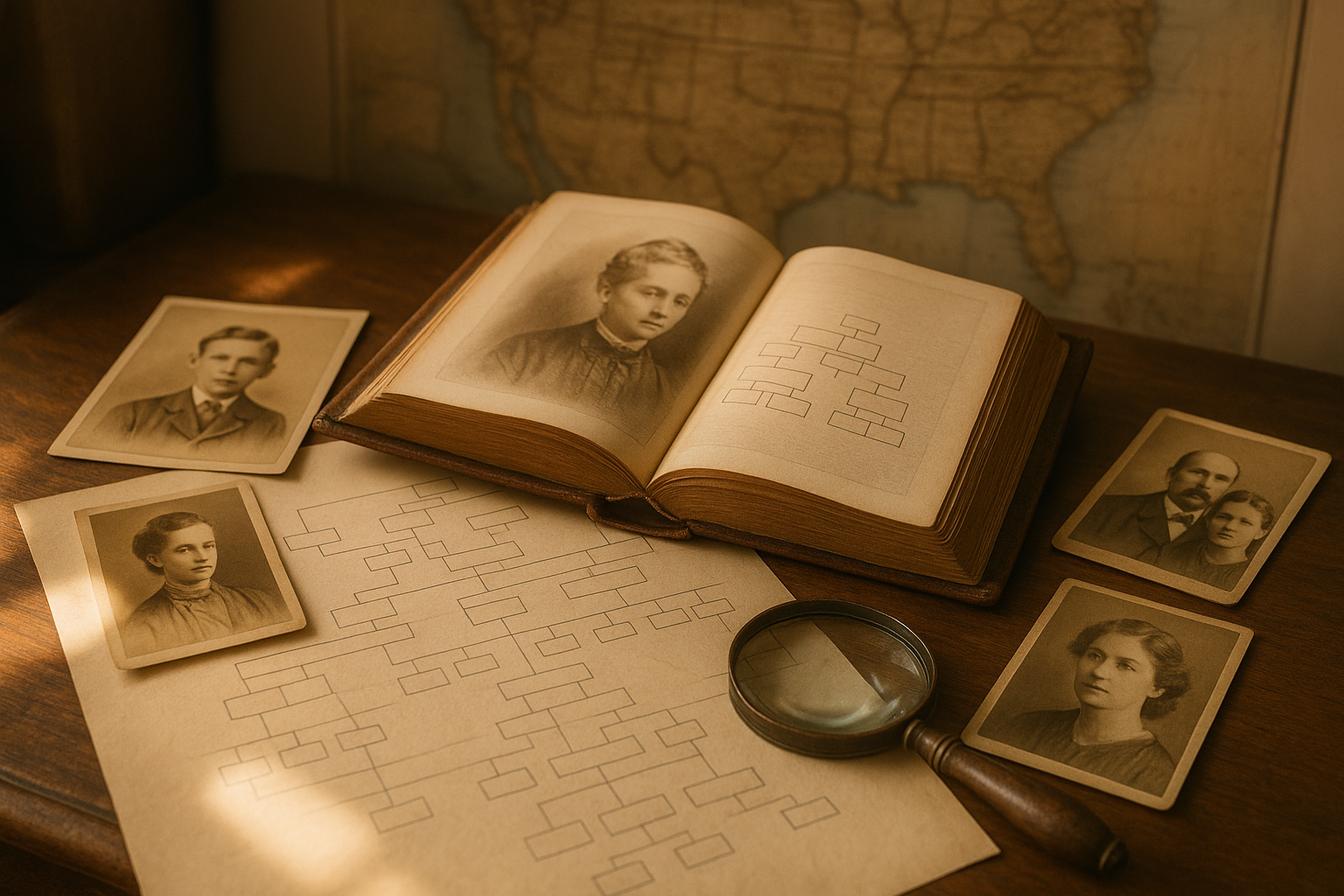
Exploring the Genealogist Career Path in the USA requires understanding genealogy as the documented study of family relationships, identity, migration, and historical context. Exploring the Genealogist Career Path in the USA becomes practical when you follow a repeatable process: interview the client, define the question, identify likely records, search original or reliable copies, compare evidence, cite each claim, and write a conclusion with limitations.
A normal project may include a 60-minute client interview, census and vital-record searches, courthouse or archive visits, source evaluation, family-tree construction, and a written report. The researcher may compare two men with the same name by examining residence, occupation, witnesses, neighbors, and ages. A birth date repeated on an unsourced tree is not stronger than a contemporaneous record with a citation.
Common specialties include probate and heir research, forensic genealogy, genetic genealogy, house and property history, African American genealogy, Jewish genealogy, immigration research, and lineage-society applications. Each requires different records: probate files may identify heirs, deeds may establish property ownership, and passenger lists may connect an immigrant to a town of origin.
Useful repositories and tools include the National Archives, FamilySearch, Ancestry, MyHeritage, Fold3, state archives, county courthouses, libraries, and historical societies. The Library of Congress collections and local newspapers can add context, but an online index is only a finding aid. Based on our analysis, the strongest conclusion usually rests on several independent sources rather than one attractive hint.
How to Become a Genealogist: Education and Essential Skills
Exploring the Genealogist Career Path in the USA does not usually require a college degree or state license. Exploring the Genealogist Career Path in the USA is easier to enter with formal study in history, library science, anthropology, archival studies, or law, especially if you want institutional employment, probate work, or advanced research responsibility.
Clients and employers value historical reasoning, paleography, geography, interviewing, source criticism, report writing, organization, spreadsheet use, and precise citation. You should be able to explain why a record is reliable, identify what a record cannot prove, and distinguish a direct statement from an inference. The National Genealogical Society offers education, Boston University provides genealogy studies, and local societies, community colleges, and university archival programs offer additional routes.
Use this learning sequence:
- Master U.S. census and vital records, including indexes, images, amendments, and access restrictions.
- Study immigration, naturalization, land, probate, church, military, and court records.
- Learn the regional history, boundary changes, languages, and record practices of your chosen area.
- Practice evidence analysis with conflicting names, dates, and relationships.
- Complete supervised case studies and ask an experienced researcher to critique your citations.
Set measurable benchmarks: complete 10 documented research projects, transcribe at least 50 historical documents, and create a portfolio containing citations, research plans, conclusions, and negative-search logs. We recommend recording every database, repository, date range, spelling variant, and result. Those habits matter more than memorizing website names.
Genealogist Certification, Credentials, and Professional Standards
Exploring the Genealogist Career Path in the USA becomes more credible when you understand the difference between certification and accreditation. Exploring the Genealogist Career Path in the USA does not require either credential, and neither guarantees employment, but both can demonstrate competence to clients who cannot easily judge research quality before hiring you.
The Board for Certification of Genealogists evaluates a portfolio that typically includes a client-style research report, a case study, a kinship-determination project, document work, and evidence that you follow professional standards. The International Commission for the Accreditation of Professional Genealogists, commonly called ICAPGen, assesses expertise in a geographic region through examinations and related requirements. A credential is evidence of preparation, not a promise of a particular result.
The Association of Professional Genealogists supports networking, education, and ethical practice. The National Genealogical Society and regional societies provide lectures, study groups, conferences, and continuing professional development. In our experience, participating in these communities can reveal archive contacts and practical standards that a self-directed course may miss.
Serious portfolio preparation often takes 12 to months, although a specialist with prior training may move faster. Write a code for your business covering privacy, informed consent, transparent fees, source citations, conflict-of-interest disclosures, and careful treatment of DNA, adoption, and donor-conception records. Review that code annually; professional judgment changes as laws, databases, and family expectations change.
A 6-Step Plan for Starting a Genealogy Career
Exploring the Genealogist Career Path in the USA is easier when you convert a broad ambition into six controlled steps. Exploring the Genealogist Career Path in the USA should begin with a service you can define, document, and deliver reliably rather than a promise to solve every family mystery.
- Choose a specialty. Compare regional expertise, probate research, DNA interpretation, house history, military records, or complex immigrant-family cases. Review local demand and the records you can actually access.
- Complete structured training. Take a foundational course, study record groups, and learn citation and evidence standards.
- Practice on documented projects. Work on your own family only if you can separate known facts from assumptions; complete at least organized projects.
- Build a portfolio. Prepare a five-generation proof summary, a source-cited family narrative, and a research plan that records searches producing no result.
- Gain supervised experience. Volunteer at historical societies, archives, libraries, indexing projects, internships, or pro bono assignments with written permission to use anonymized work.
- Begin with scoped paid assignments. Define one question, one time period, one geographic scope, deliverables, and a realistic deadline.
Use a 90-day launch schedule: spend days 1–30 in training, days 31–60 producing portfolio work, and days 61–90 networking, comparing prices, and contacting potential clients. We found that this staged approach exposes skill gaps before they become expensive client problems.

Where Genealogists Work in the United States
Exploring the Genealogist Career Path in the USA can lead to genealogy companies, public libraries, university archives, museums, historical societies, record repositories, law firms, probate practices, adoption agencies, and government contractors. Exploring the Genealogist Career Path in the USA also includes adjacent jobs where family-history skills are useful: archivist, librarian, historian, records manager, museum educator, historical consultant, forensic researcher, and DNA research specialist.
Freelancers may provide client research, lineage-society applications, lectures, workshops, writing, editing, virtual consultations, or research support for estate and probate cases. A freelance practice can be part-time for years; it does not have to begin with an office or a full-time income target.
Clients often come through referrals, society presentations, professional directories, a specialist website, local attorneys, estate professionals, and clearly documented sample work. A realistic example is a researcher who works hours weekly in a library, presents one workshop each month, and completes two weekend client projects. After months of referrals and repeat work, that person may reduce library hours and test full-time independence.
To improve your odds, identify three nearby institutions, attend two public programs, and contact five professionals whose clients may need research support. According to the U.S. Bureau of Labor Statistics, related library, archival, and museum occupations have distinct education and employment requirements, so read each posting rather than assuming the title genealogist will appear.
Genealogist Salary, Rates, and Business Models
Exploring the Genealogist Career Path in the USA produces uneven income because location, credentials, specialty, turnaround time, employer type, and business model all matter. Exploring the Genealogist Career Path in the USA may lead to salaried employment, hourly research, fixed-fee projects, retainers, teaching, or a mix of services; no single number represents the profession.
Common models include hourly research, fixed-fee packages, monthly retainers, paid consultations, workshops, and subscription-style research updates. Before setting a rate, track billable and nonbillable time separately. Include software, database subscriptions, archive travel, scanning, insurance, taxes, payment processing, website costs, and professional dues. A researcher who bills only of a 40-hour week cannot price as though all hours generate revenue.
For example, a 12-hour project at $75 per hour creates $900 in gross revenue. That amount is before travel, subscriptions, taxes, administration, unpaid correspondence, and time spent writing the proposal. If travel costs $120 and administrative work adds hours, the effective return is much lower than the headline figure.
Use a written contract that defines the research question, sources to be searched, deliverables, deadlines, payment schedule, refunds, privacy, and what happens when records cannot prove a relationship. We recommend stating that a professional search can produce a negative or inconclusive result. A clear contract prevents a client from interpreting a research plan as a guarantee of discovery.
Technology, DNA Testing, and Genealogy Research in 2026
Exploring the Genealogist Career Path in the USA now includes digital research and genetic evidence, but Exploring the Genealogist Career Path in the USA still depends on human reasoning. In 2026, AncestryDNA, 23andMe, MyHeritage DNA, FamilyTreeDNA, GEDmatch, DNA Painter, and chromosome-comparison tools can identify useful leads, yet none can independently prove every ancestor or relationship.
Build practical technology skills in genealogy software, cloud backups, optical character recognition, digital scanning, spreadsheet analysis, geographic mapping, citation tools, and secure file sharing. Maintain two backups, preserve original images, and use a consistent file naming system. OCR can speed transcription, but a 19th-century handwritten word still requires visual checking because a single misread surname can redirect an entire project.
Explain DNA limitations before analysis. Ethnicity estimates are statistical models, shared-DNA amounts can overlap across relationship ranges, endogamy can inflate shared segments, and adoption discoveries can affect several living relatives. Testing companies have different databases and matching algorithms. The National Human Genome Research Institute provides useful background on genetic ancestry testing and its limitations.
Use a privacy workflow: obtain written permission, minimize identifying details, protect files with multifactor authentication, avoid uploading data without consent, and explain deletion options. Genetic genealogy for missing-person and unidentified-remains cases is a developing specialty; it requires legal authority, careful ethical review, validated methods, and sensitivity to the impact on families.
Challenges, Ethics, and the Reality of the Work
Exploring the Genealogist Career Path in the USA involves difficult evidence and difficult conversations. Exploring the Genealogist Career Path in the USA is not a promise of complete answers because records may be missing, courthouses may close, certificates may be restricted, and fires or floods may destroy collections. Names change across languages, boundaries move, and two unrelated people may share the same name.
Ethical questions become serious when research concerns living people, adoption, donor conception, non-paternity discoveries, enslaved ancestors, medical information, or identifiable family details. Never publish a living person’s information merely because you found it in a database. Ask what the client is authorized to know, obtain consent before contacting relatives, and separate historical documentation from speculation.
When a project is inconclusive, label each statement as a fact, probable conclusion, hypothesis, or unresolved question. Do not promise a dramatic discovery. A careful report might say that two records support the same parentage but that the missing probate file prevents a definitive conclusion.
Use a written intake covering goals, known family information, privacy limits, budget, deadlines, and permission to contact relatives or repositories. Our expert checklist includes citing every key claim, preserving original images, recording repository call numbers, logging negative searches, obtaining permission before sharing DNA findings, and disclosing limitations. Four separate review passes—names, dates, citations, and privacy—can catch errors before delivery.
Career Opportunities Often Overlooked by Beginners
Exploring the Genealogist Career Path in the USA includes more than family-tree reports. Exploring the Genealogist Career Path in the USA can lead to historical property research, insurance and title research, heir research, museum interpretation, documentary consulting, historic preservation, and records digitization. These services reward researchers who can read deeds, maps, tax records, court files, photographs, and institutional finding aids.
Probate attorneys and estate administrators may need help locating heirs, but a genealogist must stay within clear boundaries. You can identify records, document relationships, and explain the strength of evidence; you should not give legal advice or state that someone is legally entitled to an estate. A written referral to qualified counsel protects both the researcher and the client.
Public-history opportunities include exhibit development, oral-history projects, cemetery documentation, community archives, and culturally specific heritage programs. Multilingual skills, paleography, geographic specialization, and knowledge of colonial, Indigenous, African American, Hispanic, Asian American, or Eastern European records can create a defensible niche.
Test a specialty before spending heavily on branding or advanced credentials. Complete one volunteer project, deliver one educational presentation, and conduct one paid pilot with a written scope. After those three tests, review demand, enjoyment, research access, error risk, and client feedback. We recommend choosing the area where your evidence skills and local knowledge produce a genuine advantage.
How to Build Trust and Find Your First Clients
Exploring the Genealogist Career Path in the USA becomes commercially viable when potential clients can see how you work. Exploring the Genealogist Career Path in the USA should therefore be presented through a clear service page, two evidence-based research examples, a local society presentation, appropriate testimonials, and referral relationships rather than broad claims about discovering anyone’s entire ancestry.
Your portfolio should show the research question, geographic and date scope, repositories searched, citations, reasoning, limitations, and final recommendations. Remove identifying details from living people and obtain permission before publishing client material. A strong sample explains why one record was preferred over another and records searches that produced no answer.
Build connections through the Association of Professional Genealogists directory, local societies, library programs, historical conferences, and attorney or estate-planning networks. Contact people with a specific offer: for example, a 20-minute presentation on locating immigrant ancestors in county records, followed by a one-page research checklist.
A suitable first-client offer might be a 90-minute consultation plus a written research plan. Define the records, geographic area, time limit, deliverable length, follow-up terms, and fee. Avoid promises such as find every ancestor or prove your family is royalty. Based on our research, precise promises tied to documented tasks create more trust than dramatic marketing language.
Conclusion: Your Next Steps Toward a Genealogy Career
Exploring the Genealogist Career Path in the USA is accessible because a mandatory national license is generally absent, but Exploring the Genealogist Career Path in the USA is not effortless. Credible work requires research training, evidence standards, ethical judgment, consistent practice, and the ability to tell a client that the records do not support the desired conclusion.
Take these actions during the next seven days:
- Join one local genealogical society.
- Select one specialty or geographic region.
- Enroll in a foundational course through a recognized provider.
- Choose one documented family-history project.
- Create a research log with searches, citations, and unresolved questions.
By day 30, finish a small portfolio sample and volunteer for one archive, library, cemetery, indexing, or historical-society task. By day 90, complete three portfolio deliverables, attend two professional events, compare five competitors’ pricing models, and offer your first consultation or educational presentation. We recommend reviewing your results against three measures: evidence quality, client usefulness, and whether the work supports your desired schedule.
Compare employment, freelance research, archives, forensic work, DNA specialization, and public history against your income needs and tolerance for irregular work. The strongest professionals do not win trust with a grand promise. They earn it one well-sourced conclusion at a time.
Key Takeaways
- A genealogy career usually does not require a mandatory U.S. license or degree, but structured training and evidence-based practice are essential.
- Start with a defined specialty, documented projects, a portfolio, supervised experience, and carefully scoped paid assignments.
- Certification through BCG and accreditation through ICAPGen can demonstrate competence, but neither guarantees employment or income.
- DNA tools support documentary research; informed consent, privacy controls, and careful interpretation are mandatory.
- Your strongest business asset is a reputation for accurate citations, honest limitations, clear contracts, and ethical treatment of sensitive family information.
Frequently Asked Questions
Do you need a degree to become a genealogist?
No. The United States generally does not require a professional license or college degree to perform genealogical research. However, structured training, careful citations, supervised practice, and credentials such as BCG certification or ICAPGen accreditation can make your work more credible.
How much does a genealogist make in the United States?
Income varies widely because genealogists may work as employees, freelancers, consultants, educators, or specialized researchers. A freelancer might charge $50 to $100 or more per hour, while salaried work depends on the employer, region, experience, and job classification.
How do you start a genealogy career?
Start by learning census, vital, immigration, land, probate, and church records; then complete documented practice projects. Build a portfolio, volunteer with a society or archive, choose a specialty, and accept narrowly defined paid assignments only when you can explain your methods and limitations.
Can DNA testing replace traditional genealogy research?
Professional genealogists use DNA as one category of evidence rather than treating an ethnicity estimate or match as proof of a relationship. Documentary records, shared DNA amounts, family trees, consent, privacy controls, and the possibility of endogamy must all be evaluated together.
What is the difference between genealogy certification and accreditation?
Certification from the Board for Certification of Genealogists evaluates professional competence through a portfolio, while accreditation through the International Commission for the Accreditation of Professional Genealogists evaluates expertise in a specific geographic region. Neither credential guarantees employment or a particular income.
Is Exploring the Genealogist Career Path in the USA a viable career choice?
Exploring the Genealogist Career Path in the USA is most realistic when you treat it as a research profession rather than a shortcut to easy freelance income. You should expect to spend months building skills, examples, relationships, and a reputation for accurate work.
